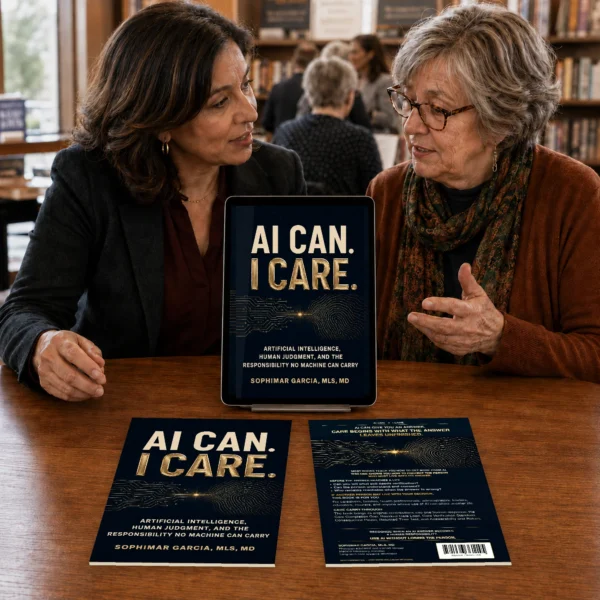

Bring everyone’s care into one shared family plan.
View Home, With a PlanBESTCAREMATCH™ · SIGNATURE PATH 03 · PRIVATE-FAMILY PLANNING
When your family is planning care with its own funds, there can be a lot to talk through. Private Path helps you bring questions about aging at home, shared responsibilities, paid help, and backup plans into one place.
- Nationwide private-family planning
- 178-page fillable digital System
- Separate optional Washington placement path


MORE THAN A CARE SEARCH
Organize Questions About Home, Care, Costs, and Family Responsibilities
Can Mom stay at home? Who can help? What can we afford? Private Path gives your family a place to think through these questions, listen to each person’s wishes, and write down what you agree to do next.
What has changed?
Bring observations, preferences, support gaps, and unanswered questions into one calmer view.
What decisions affect each other?
See where care, home, family capacity, cost, authority, and backup planning overlap.
What needs attention first?
Choose a manageable starting point and prepare the questions your family wants to explore.
FROM PRESSURE TO A USABLE RECORD
Record Care Preferences, Open Questions, and Agreed Actions
Home, With a Plan helps you keep your loved one’s wishes, practical observations, open questions, and next steps together. Your family can return to the same record as the conversation develops.
| Decision pressure | What the System helps organize | Usable family record |
|---|---|---|
| Mom or Dad wants to remain at home, but family members see different needs. | Observed facts, the parent’s preferences, assumptions, support gaps, and questions that still require qualified verification. | A written starting point your family can revisit together. |
| Everyone agrees something must happen, but no one owns the next step. | Action ownership, timing, completion evidence, and a backup route if the first plan cannot be completed. | Named responsibility and follow-through the family can revisit. |
| Paid home support or another care option is being discussed without a consistent comparison. | Questions about available help, what a service includes, costs, and details to confirm directly. | A comparison record that separates known facts from unanswered questions. |
| A hospital discharge, caregiver absence, or sudden change exposes hidden gaps. | Immediate support needs, contact questions, transition responsibilities, backup triggers, and the next review. | A clearer transition and backup record for the family conversation. |
The examples describe planning support, not promised outcomes. Individual care, coverage, legal, financial, safety, and placement decisions remain with the appropriate qualified professionals and responsible authorities.
CHOOSE THE SUPPORT THAT FITS
Two distinct private-family paths. Use either one—or both.
The national planning System stands on its own. Washington placement assistance is separate and optional. A purchase never requires a placement relationship, and placement assistance never requires a purchase.
PLAN PRIVATELY
Build the family’s written decision plan.
Use Home, With a Plan to organize observations, parent preferences, support gaps, questions for professional verification, responsibility, backup, and review points.
EXPLORE CARE OPTIONS
Request private-pay placement assistance.
Washington families may request separate help exploring participating licensed care options. Families are not charged for BestCareMatch placement services.

THE COMPLETE PRIVATE-FAMILY SYSTEM
Home, With a Plan™
A 178-page, fillable and printable private-family decision System for aging at home, coordinating support, comparing paid care, preserving the parent’s voice, assigning next actions, and knowing what the family still needs to verify.
- 178-page digital action System
- 14 connected decision Systems
- 14 completed family outputs
- Private Family Plan Portfolio
- Four Conversation Briefs
- Action ownership and review points
- Official U.S. source directory
- Private family-use license
- Readable 14-point text
One-time purchase. No subscription.
Format clarity: Your $99 purchase includes the complete 178-page fillable and printable PDF. A separate physical + digital edition is planned, with its release date to be confirmed. Request one availability notice; requesting a notice is free.
Digital purchases are non-returnable after access or download except where required by law or if the delivered file is defective. Review the complete product details before purchasing.
THE VALUE IS THE COMPLETED PLAN
Move from repeated conversations to one written family record.
Keep your loved one’s preferences, what you have learned, and the questions for qualified professionals in one working record. Add the next action and a time to return to the plan.
What the family can leave with
- A visible decision basisWhat the family observed, learned, and still needs to verify.
- The parent’s voice in writingPreferences, goals, limits, and chosen supporters remain part of the record.
- Named responsibilityWho owns the next step, when it will be reviewed, and what shows completion.
- A backup pathWhat the family may reconsider if needs, capacity, support, or conditions change.
OPTIONAL WASHINGTON PATH
When planning becomes a care-options search.
Looking for a care home or community? Explore Private Pay care guidance and ask about the support available in your state. Washington families can also discuss in-person placement help. Home, With a Plan remains a separate planning resource that you can use independently.
CONNECT CARE QUESTIONS WITH COVERAGE INFORMATION
Confirm Coverage With the Responsible Program or Plan
A family plan may uncover questions about hospital care, home health, skilled nursing, hospice, equipment, prescriptions, enrollment, or long-term support. Write down the specific service and question, then confirm coverage with the responsible program, plan, or licensed professional.
For calm, educational Medicare reading, families may continue to VastShield’s national Medicare Series. Read together, write down the exact coverage question, then verify the current answer with Medicare.gov, the plan, the responsible agency, or an appropriately licensed professional.
A BESTCAREMATCH™ PRIVATE PATH COLLECTION
The First Three Gifts
For Families Planning Private-Pay Care. Three starting tools, together in one 30-page private-family reader. Explore a conversation starter, a family alignment map, and a way to choose your next three priorities.
Can Mom or Dad Continue Living at Home?
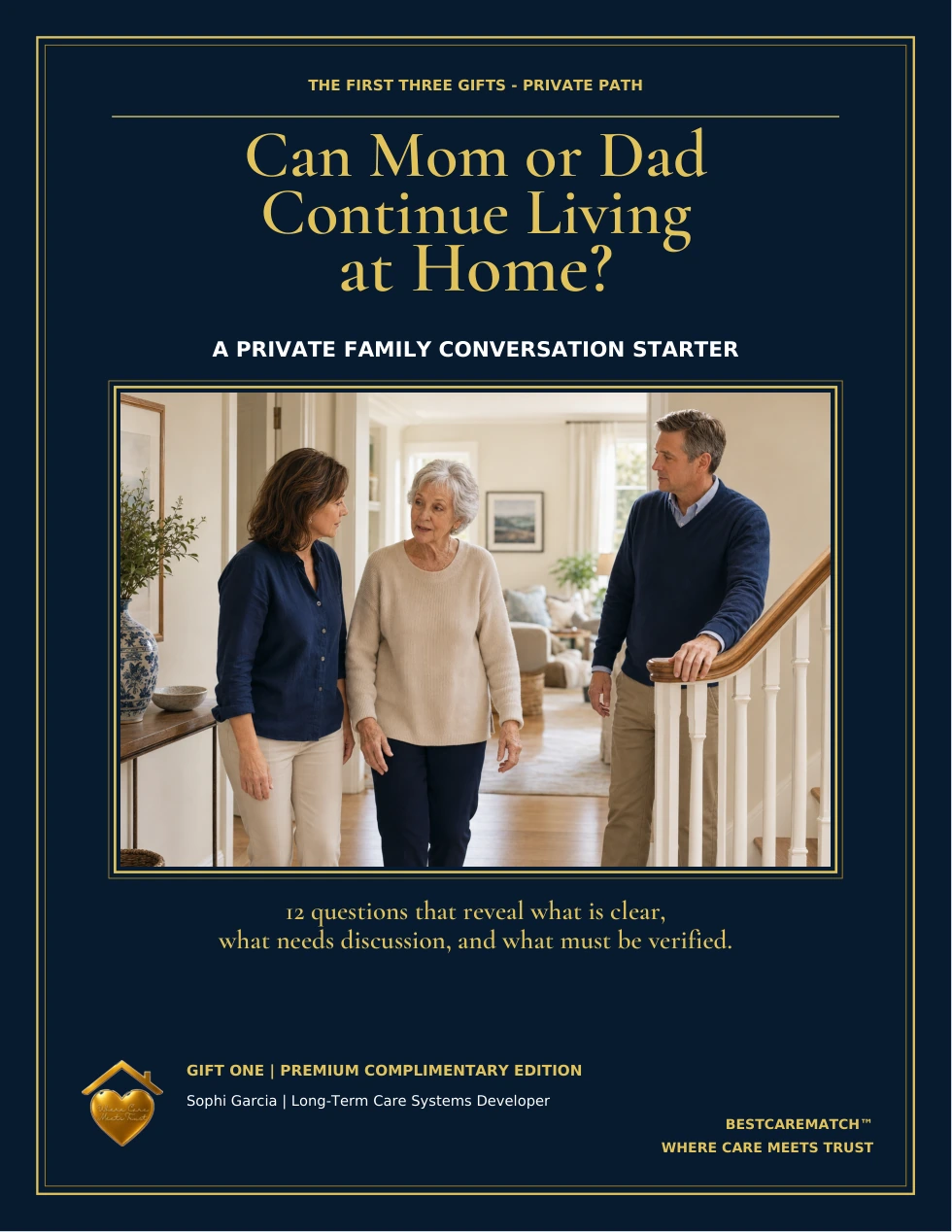
A private family conversation starter that distinguishes what the family knows, what needs discussion, and what still requires appropriate verification.
Do We See the Same Plan?

A Family Care Alignment Map that makes shared views, uncertainty, and differing perspectives visible—without declaring a winner.
The Priority-3 Selector
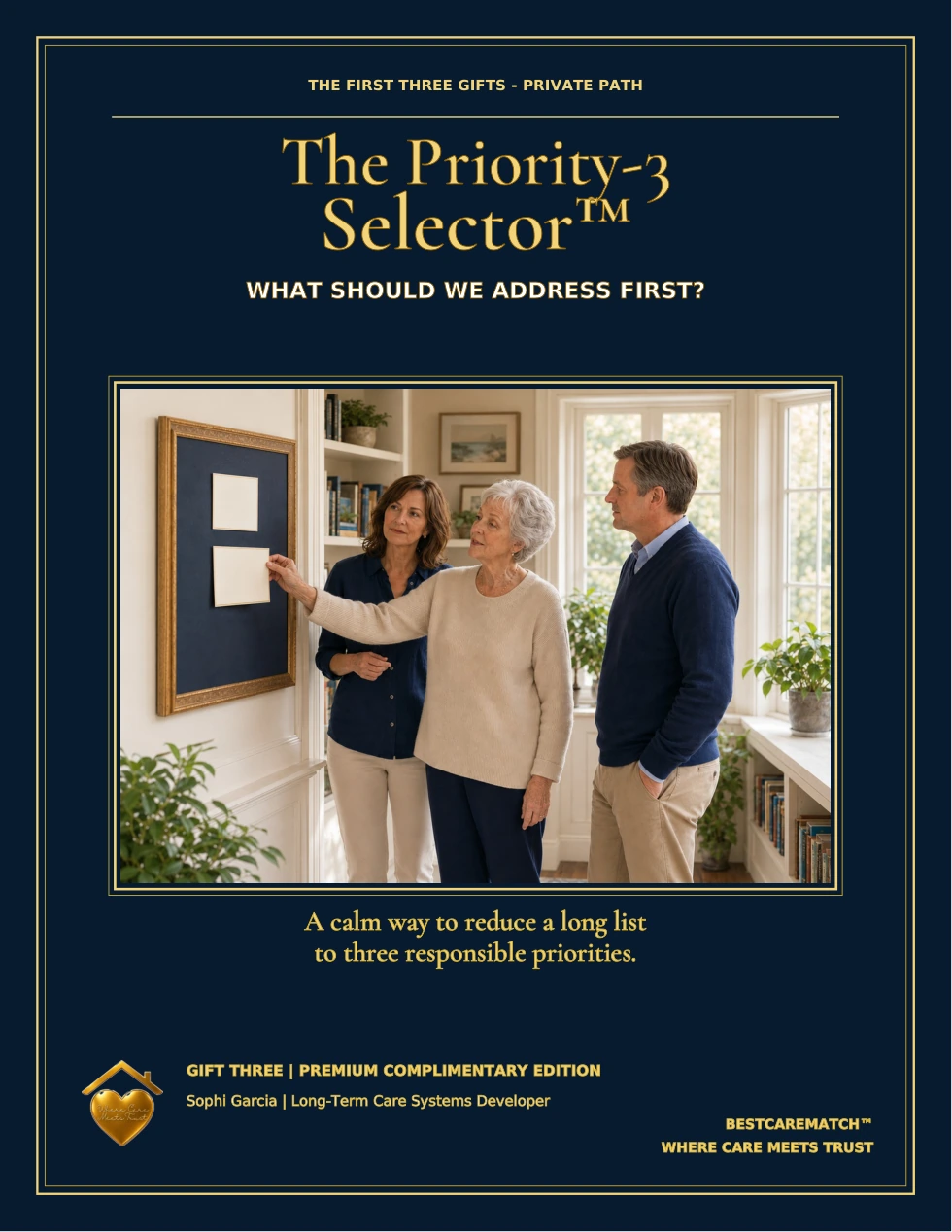
A focused decision tool that helps the family name the three care decisions needing attention first and record one manageable next move.
Read all three gifts below
Open any section to read the complete 30-page collection without an email address.
Start here · How the three gifts work
What These Three Gifts Can Help Your Family Do
START HERE | PRIVATE PATH EDITION
You do not need to solve every future decision before you begin.
These three gifts help your family create one calmer, more usable starting point.
1 | SEE CLEARLY
Make visible what your family understands today, what your loved one has expressed, and what requires qualified verification.
2 | ALIGN GENTLY
Compare different understandings without turning difference into blame, while keeping your loved one’s own words at the center.
3 | CHOOSE RESPONSIBLY
Reduce a competing list to three current priorities, each with one responsible next action and one point for review.
These gifts support family decision-preparation. They do not determine safety, capacity, legal authority, coverage, eligibility, or level of care. For immediate danger or a possible medical emergency, call 911 or the appropriate local emergency number.
Your Three-Gift Private Path
START HERE | PRIVATE PATH EDITION
Use the gifts in order for a complete starting path, or begin with the gift that matches the question your family needs to address today.
GIFT ONE | CLARITY
Can Mom or Dad Continue Living at Home?
You finish with a 12-question clarity check and a map showing what is clear, what needs discussion, and what needs verification.
GIFT TWO | ALIGNMENT
The Family Care Alignment Map
You finish with different understandings made visible, a distinct place for your loved one’s own words, and three shared follow-ups.
GIFT THREE | DIRECTION
The Priority-3 Selector™
You finish with three current priorities, one responsible next action for each, and a defined point for review.
SEE CLEARLY · ALIGN GENTLY · CHOOSE RESPONSIBLY
Gift one · Can Mom or Dad continue living at home?
Can Mom or Dad Continue Living at Home?
A PRIVATE FAMILY CONVERSATION STARTER
12 questions that reveal what is clear, what needs discussion, and what must be verified.
GIFT ONE | PREMIUM COMPLIMENTARY EDITION
Sophi Garcia | Long-Term Care Systems Developer
BESTCAREMATCH™
WHERE CARE MEETS TRUST
Read This First
GIFT ONE | BEGIN WITH CLARITY
A family may begin with a yes-or-no question: Can our parent remain at home? The more useful starting point is whether the current arrangement is understood, supported, and able to be reviewed as needs change.
SURFACES ASSUMPTIONS
Shows where family members may be working from different information.
SEPARATES DISCUSSION FROM VERIFICATION
Some questions belong in a family meeting; others require an appropriate professional.
CREATES ONE NEXT STEP
Helps the family identify who will clarify what, and by when.
This starter does not decide
It does not diagnose a condition, assess decision-making capacity, certify that a home arrangement is safe, determine eligibility or coverage, or choose a level of care.
URGENT SITUATIONS
If someone is in immediate danger or may need emergency medical attention, call 911 or the appropriate local emergency number. Do not use this resource to delay urgent help.
The Decision Is Larger Than the House
SEE THE WHOLE ARRANGEMENT
Living at home depends on more than the building. A workable plan makes four areas visible at the same time.
1 | THE PERSON
Current abilities, health concerns, routines, preferences, and changes that need evaluation.
2 | THE HOME
Access, movement, bathroom use, stairs, lighting, cooking, communication, and emergency exit.
3 | THE SUPPORT
Family availability, paid help, professional services, transportation, and follow-through.
4 | THE CONTINUITY
Backup coverage, changing needs, review dates, and conditions that would trigger reassessment.
A coverage reality worth verifying
Medicare home health coverage is eligibility-based and limited. Medicare states that it does not pay for 24-hour care at home, home meal delivery, unrelated homemaker services, or custodial or personal care when that is the only care needed. Verify the person’s specific eligibility, benefits, and other payment options before relying on an assumption.
Verified sources appear on page 9.
The 12-Question Family Clarity Check
QUESTIONS 1-4
Choose the most honest status. Do not force agreement and do not treat the result as a score.
1
What has changed during the past 30 to 90 days – and which observations are repeated rather than isolated?
Clear today Needs discussion Needs verification
2
Which daily activities can your parent complete independently, and where is help already being provided?
Clear today Needs discussion Needs verification
3
Has an appropriate professional recently evaluated any new concern involving health, mobility, memory, mood, medication, or function?
Clear today Needs discussion Needs verification
4
What does your parent want to preserve most about living at home, and what support are they willing to consider?
Clear today Needs discussion Needs verification
The 12-Question Family Clarity Check
QUESTIONS 5-8
Choose the most honest status. Do not force agreement and do not treat the result as a score.
5
Which parts of the home make daily movement, bathing, stairs, cooking, communication, or emergency exit more difficult?
Clear today Needs discussion Needs verification
6
Who currently notices changes, attends appointments, manages follow-up, and checks whether agreed actions were completed?
Clear today Needs discussion Needs verification
7
If the primary helper became unavailable tomorrow, who could step in, for how long, and with what information?
Clear today Needs discussion Needs verification
8
Which needs call for family help, household support, personal care, or a licensed or skilled professional – and have those boundaries been verified?
Clear today Needs discussion Needs verification
The 12-Question Family Clarity Check
QUESTIONS 9-12
Choose the most honest status. Do not force agreement and do not treat the result as a score.
9
What would paid support need to accomplish, during which hours, and how would the family verify reliability?
Clear today Needs discussion Needs verification
10
What is the current monthly cost of staying home, including paid services, transportation, home changes, and unpaid family time?
Clear today Needs discussion Needs verification
11
What specific changes would lead the family to seek prompt professional guidance or reconsider the current arrangement?
Clear today Needs discussion Needs verification
12
Has the family agreed on the next action, the responsible person, the completion date, and the date the plan will be reviewed?
Clear today Needs discussion Needs verification
Build Your Family Clarity Map
TURN THE ANSWERS INTO DIRECTION
Transfer each question number into the column that matches your answer. This is not a risk score. Its purpose is to show where the family should direct its next conversation and verification work.
CLEAR TODAY
Document what is known and schedule a review.
NEEDS DISCUSSION
Bring the parent and family into a focused conversation.
NEEDS VERIFICATION
Identify the appropriate professional or official source.
READ THE PATTERN WITHOUT OVERINTERPRETING IT
Preserve clear information, schedule one family conversation for discussion items, and name the exact qualified source for verification items.
The 20-Minute Family Conversation
CREATE ONE SHARED NEXT MOVE
The purpose is not to settle every future decision. It is to create one shared understanding and one responsible next step.
1
What have we observed?
Name facts, dates, and repeated patterns. Avoid conclusions or labels.
2
What matters most to our parent?
Record the parent’s priorities, concerns, and preferred participation.
3
What remains unclear?
Separate family disagreement from information that no one has yet verified.
4
What will be verified, by whom, and by when?
Name the professional, agency, insurer, provider, or official source.
5
When will we review what we learned?
Set a date. A plan without a review point quietly becomes an assumption.
Our next responsible step is:
What This Starter Has Made Visible
COMPLETE THE STARTER
You now know which parts of the family’s understanding are clear, which require a shared conversation, and which should be verified before a larger decision is made.
What remains beyond this starter
A full home-support feasibility profile and support-gap map
A written record of parent priorities and decision participation
Paid-care requirements and comparable provider verification
Cost visibility, backup coverage, and family responsibility assignment Reassessment triggers, a 30-day plan, and a final family decision summary Home, With a Plan™ The Private Family System for aging at home, coordinating support, and knowing when more care is needed.
OFFICIAL SOURCES – VERIFIED AUGUST 2026
National Institute on Aging – Aging in Place
National Institute on Aging – What Is Long-Term Care?
Medicare.gov – Home Health Services
Administration for Community Living – Eldercare Locator | 800-677-1116 Educational decision-preparation only. Not medical, legal, financial, insurance, or placement advice.
This resource does not determine whether a person can live safely at home or what level of care is appropriate. Verify current health, eligibility, coverage, licensing, and care requirements with appropriate professionals and official sources. Call 911 for immediate danger.
Gift two · The Family Care Alignment Map
The Family Care Alignment Map
DO WE SEE THE SAME PLAN?
A calm way to discover where your family agrees, where perspectives differ, and what needs clarification next.
GIFT TWO | PREMIUM COMPLIMENTARY EDITION
Sophi Garcia | Long-Term Care Systems Developer
BESTCAREMATCH™
WHERE CARE MEETS TRUST
Before the Family Conversation
GIFT TWO | BEGIN PRIVATELY
Families can care deeply about the same person and still carry different versions of the plan. One person may believe home support is temporary. Another may assume it is the long-term direction. A parent may understand the plan differently from everyone else.
THE GOAL IS NOT INSTANT AGREEMENT
The goal is to make each person’s understanding visible before the family tries to solve everything.
Use this map when…
Different family members are acting on different assumptions.
A parent’s wishes have not been clearly heard or recorded.
Responsibilities are being discussed, but the overall direction is unclear.
A decision keeps returning without a shared next step.
A respectful starting agreement
Each person completes the private reflection before comparing answers. Differences are information – not proof that someone does not care.
EDUCATIONAL PLANNING TOOL
It does not determine safety, capacity, legal authority, care level, or placement suitability.
My Understanding of the Plan
STEP 1 | COMPLETE SEPARATELY
Name or initials Date
1. What do I believe the current plan is?
2. What does Mom, Dad, or our family member appear to want?
3. What am I most concerned could be overlooked?
4. What responsibility do I believe I have agreed to?
5. What do I need clarified before I can support the next step?
Complete this page privately. Do not edit another person’s answers.
The Family Care Alignment Map
STEP 2 | COMPARE WITHOUT DEBATING
Write short phrases only. If someone is unsure, record ‘not yet clear.’ Add more participants on a separate copy of this page.
QUESTION PARENT / FAMILY
MEMBER
PERSON 2 PERSON 3
Current plan
Parent’s preferred direction
Main concern
Who is doing what
Next decision needed
LOOK FOR PATTERNS – NOT WINNERS
Circle back to any answer that is different, missing, or based on an assumption.
The Parent-Voice Check
STEP 3 | PROTECT THE CENTER OF THE PLAN
Where the older adult can participate, their goals, routines, tolerances, relationships, and preferences should be heard directly – not reconstructed only through the family.
What matters most to the person at the center?
What they want to preserve
What they do not want assumed
What they are willing to consider
What they want help deciding
Whose words are recorded above?
The person’s own words Supported conversation Family’s current understanding If the person cannot participate fully, do not use this page to determine legal decision-making authority. Record what is known, what remains uncertain, and who is authorized to act.
What Is Aligned – and What Is Not Yet Clear?
STEP 4 | TURN DIFFERENCES INTO QUESTIONS
WE ALREADY AGREE ON WE SEE DIFFERENTLY
WE DO NOT YET KNOW WE NEED TO VERIFY WITH A QUALIFIED SOURCE
Convert assumptions into neutral questions
Instead of: You never understood the plan.
Ask: What are each of us currently expecting to happen next?
Instead of: You are refusing to help.
Ask: What can each person realistically take on – and for how long?
A difference becomes actionable when the family can name what must be clarified.
The 20-Minute Alignment Conversation
STEP 5 | LEAVE WITH A SHARED NEXT MOVE
1 | OPEN – 2 MINUTES
We are comparing what each of us understands.
We are not deciding everything today.
2 | LISTEN – 6 MINUTES
Each person shares one concern and one hope without interruption.
3 | COMPARE – 6 MINUTES
Name one agreement, one difference, and one fact that still needs verification.
4 | CHOOSE – 4 MINUTES
Select no more than three follow-ups, with one owner and one date for each.
5 | CLOSE – 2 MINUTES
Confirm what was decided today – and what was deliberately left open.
A pause is appropriate when…
Voices are rising or someone feels cornered.
The discussion depends on medical, legal, financial, or service information that has not been verified.
The older adult asks to stop or needs support to participate.
Clarity is progress – even when the final decision is not made today.
Our Three Follow-Ups
COMPLETE THE MAP
Choose only the actions that will reduce uncertainty or protect the next decision. A task is not complete until it has one owner and one date.
1
FOLLOW-UP
OWNER BY WHEN
2
FOLLOW-UP
OWNER BY WHEN
3
FOLLOW-UP
OWNER BY WHEN
The decision we are not forcing today
WHEN THE FAMILY NEEDS MORE THAN ONE CONVERSATION
Home, With a Plan™ offers a fuller private-family system for organizing decisions and next steps.
BESTCAREMATCH™ | WHERE CARE MEETS TRUST
Educational planning resource. Not medical, legal, financial, or placement advice. © 2026 BestCareMatch LLC.
Gift three · The Priority-3 Selector™
The Priority-3 Selector™
WHAT SHOULD WE ADDRESS FIRST?
A calm way to reduce a long list to three responsible priorities.
GIFT THREE | PREMIUM COMPLIMENTARY EDITION
Sophi Garcia | Long-Term Care Systems Developer
BESTCAREMATCH™
WHERE CARE MEETS TRUST
Start With What Matters
Whose words are reflected above?
GIFT THREE | BEGIN WITH YOUR LOVED ONE
A responsible priority begins with what matters to your mom, dad, or loved one – not only with your family’s longest list.
What does your mom, dad, or loved one most want to preserve?
What would help your loved one during the next few weeks?
What does your loved one not want your family to assume?
What would your loved one like help deciding or verifying?
Your loved one’s own words Words recorded with support Your family’s current view If your mom, dad, or loved one cannot participate fully, do not use this page to determine legal decision-making authority.
Name What Is Asking for Attention
STEP 1 | MAKE THE COMPETING LIST VISIBLE
Write every issue that is competing for attention. Use short phrases. Do not rank while you are still collecting the list.
Health questions, function, routine, comfort, preferences
HOME & SUPPORT
Home barriers, family help, paid help, backup coverage
INFORMATION & DECISIONS
Appointments, costs, coverage, authority, options to verify
A long list is not a failure. It is the raw material for a calmer selection.
YOUR LOVED ONE & DAILY LIFE
Sort the List Without Turning It Into a Score
STEP 2 | SEPARATE BEFORE SELECTING
TIME-SENSITIVE OR NEEDS PROMPT VERIFICATION
Could delay create harm, loss, disruption, or a missed deadline?
IMPORTANT FOR THE NEXT PLANNING WINDOW
Would action protect a stated goal, close a support gap, or reduce uncertainty?
CAN WAIT OR IS NOT YET CLEAR
Can this be held without neglecting an urgent need or fixed deadline?
URGENT SITUATIONS COME BEFORE THE SELECTOR
Immediate danger or a possible medical emergency: call 911 or the appropriate local emergency number. Do not delay urgent Move each possible priority into the lane that best describes what your family knows today. This is a sorting step – not a medical, legal, or safety determination.
Three clear priorities
THE PRIORITY-3 SELECTOR™ PRIVATE PATH
Three clear priorities are easier to carry forward than one unfinished list.
Selection creates direction; ownership creates movement.
Use the Four-Part Priority Test
STEP 3 | TEST BEFORE YOU SELECT
CANDIDATE 1
Reflects what matters
Needs timely attention
Reduces uncertainty or a gap
One person can own the next step
CANDIDATE 2
Reflects what matters
Needs timely attention
Reduces uncertainty or a gap
One person can own the next step
CANDIDATE 3
Reflects what matters
Needs timely attention
Reduces uncertainty or a gap
One person can own the next step
CANDIDATE 4
Reflects what matters
Needs timely attention
Reduces uncertainty or a gap
One person can own the next step
If two items remain equally important, choose the one that must be verified first or the one with the clearest responsible next action.
Test the strongest candidates. A checked box is a prompt for discussion, not a point. Verification may be the priority when your family does not yet know enough.
Our Priority 3
STEP 4 | CHOOSE ONLY THREE
Choose three priorities for the current planning window. A priority names what needs attention and why it belongs now. It is not yet the full action plan.
1
PRIORITY
WHY THIS BELONGS NOW
2
PRIORITY
WHY THIS BELONGS NOW
3
PRIORITY
WHY THIS BELONGS NOW
The rest of the list is not erased. It is held for review so your family can act without losing sight of what comes later.
Put Ownership and Time Around the Plan
STEP 5 | MAKE THE THREE EXECUTABLE
PRIORITY 1 | RESPONSIBLE NEXT ACTION
OWNER BY WHEN REVIEW / CONFIRM
PRIORITY 2 | RESPONSIBLE NEXT ACTION
OWNER BY WHEN REVIEW / CONFIRM
PRIORITY 3 | RESPONSIBLE NEXT ACTION
OWNER BY WHEN REVIEW / CONFIRM
One owner. One next action. One point for review.
For each priority, name one responsible next action. The owner coordinates that action; the owner is not automatically responsible for every part of your loved one’s care.
Keep the Plan Revisitable
COMPLETE THE SELECTOR
Our review point
REVIEW DATE OR EVENT
WHAT CHANGE WOULD CAUSE AN EARLIER REVIEW?
Home, With a Plan™
OFFICIAL PRIMARY SOURCES
Administration for Community Living – Person-Centered Planning
Centers for Medicare & Medicaid Services – Person-Centered Care
National Institute on Aging – Aging in Place
Ready.gov – Older Adults
Educational decision-preparation only. Not medical, legal, financial, insurance, emergency, or placement advice. This selector does not determine safety, capacity, legal authority, eligibility, coverage, or level of care. Verify current facts and requirements with appropriate professionals and official sources. Call 911 for immediate danger.
The Priority 3 is a current direction, not a permanent judgment.
Review it when new information arrives, circumstances change, an action is completed, or your mom, dad, or loved one asks to reconsider.
When your family needs more than three priorities, the full Private Family System organizes the larger care, support, cost, responsibility, and reassessment picture.
Keep what matters most to your loved one at the center.
THE PRIORITY-3 SELECTOR™ PRIVATE PATH
Keep what matters most to your loved one at the center.
Three responsible priorities can give your family a calmer way forward.
The gifts provide educational decision preparation. They do not assess safety, determine capacity, recommend placement, or replace medical, legal, financial, insurance, or care-professional guidance.
CLEAR BEFORE YOU BEGIN
Private Path questions
Who are the Private Path resources for?
“Private pay” describes using personal income, savings, assets, long-term-care insurance benefits, or other non-Medicaid resources for some or all care costs. Families across the United States are welcome to explore the three complimentary gifts.
Is Home, With a Plan the same as placement assistance?
Home, With a Plan is a self-guided educational planning resource for families nationwide. Personal placement assistance is a separate, optional service for Washington State families.
Can I request placement help separately?
Yes. You may explore placement assistance, use the planning resource, or choose both, according to what would help your family.
How are BestCareMatch placement services funded?
Placement services are free to families. After a successful private-pay placement, a participating licensed care provider may compensate BestCareMatch directly.
How do these resources support our family’s decisions?
They help you bring observations, preferences, questions, and next actions together, so your family is better prepared for conversations with care providers and qualified professionals.
Where can our family confirm Medicare coverage?
Use Medicare.gov, the applicable plan or program, or an authorized professional for current coverage and eligibility answers. Home, With a Plan helps you prepare the question; VastShield offers separate educational reading.
Can our family write on printed pages?
Yes. Your digital purchase includes printable pages for handwritten planning and family conversations, alongside fillable fields for on-screen use.
BEGIN WHERE THE FAMILY IS
Start with the care question closest to your family today.
Choose the 178-page complete planning System, begin with the complimentary Three Gifts reader, or request separate private-pay placement assistance in Washington.
A COMPLIMENTARY GUIDE FOR YOU AND YOUR FAMILY
Choosing a Care Home
What to Ask Before You Decide. I created this guide to help you walk into a care-home conversation with clearer questions, protect the details that matter to your family, and leave knowing what you still need answered before you decide.
 Click the cover to read the guide
You can start here before your next tour or care-home conversation.
You do not have to remember every question on the spot. Use this guide to think through how daily help works, what the actual room offer includes, what is written in the service terms, what happens when needs change, and what you want clarified for your loved one.
We make the online reading version available without a purchase. If you want your own PDF copy, contact us first so we know where to send it. We do not publish a direct PDF-download button on this page.
Want the PDF copy? Email welcome@BestCareMatch.com or text 206-586-3231. Tell us you want Choosing a Care Home: What to Ask Before You Decide and provide the email address or phone number you want us to use for your request.