
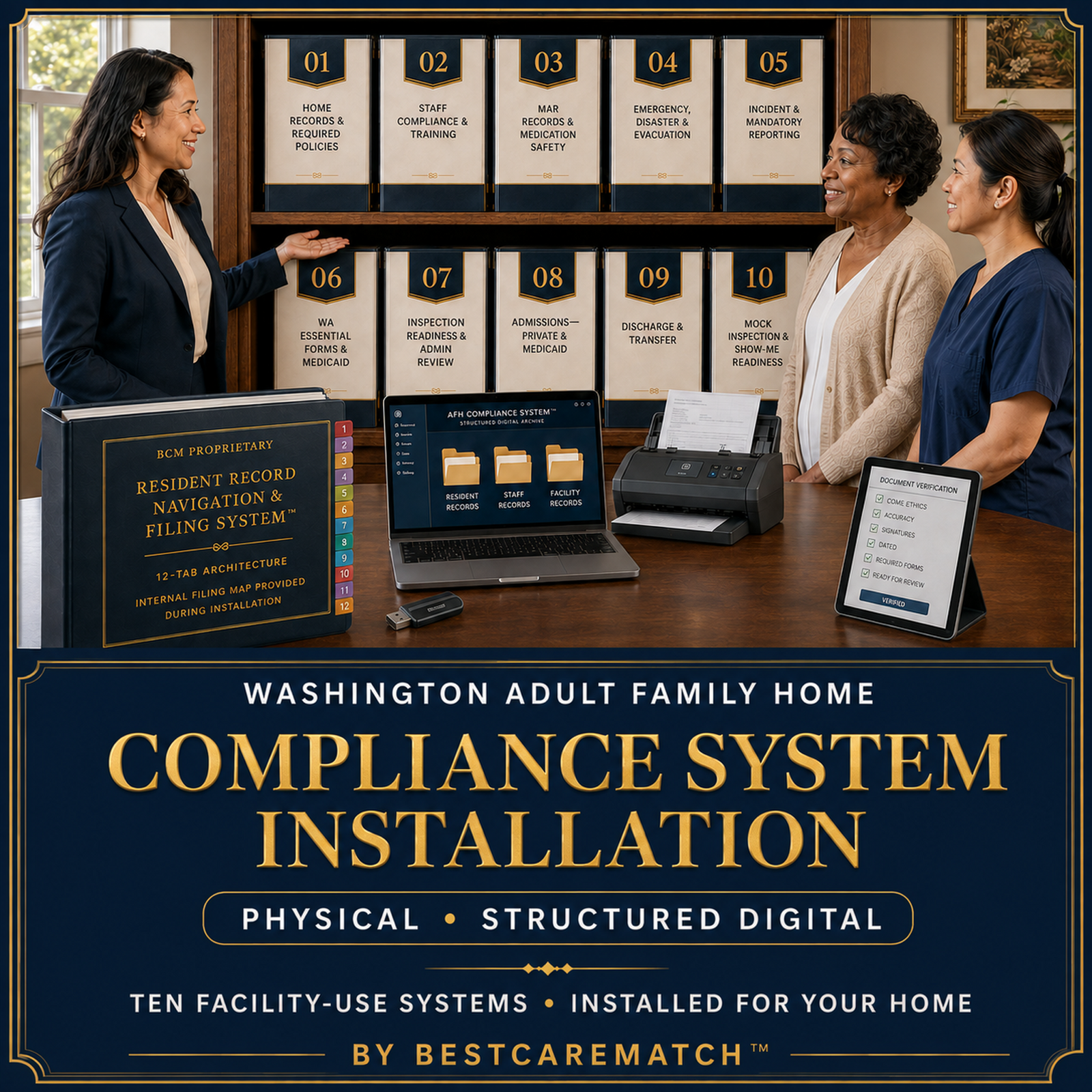

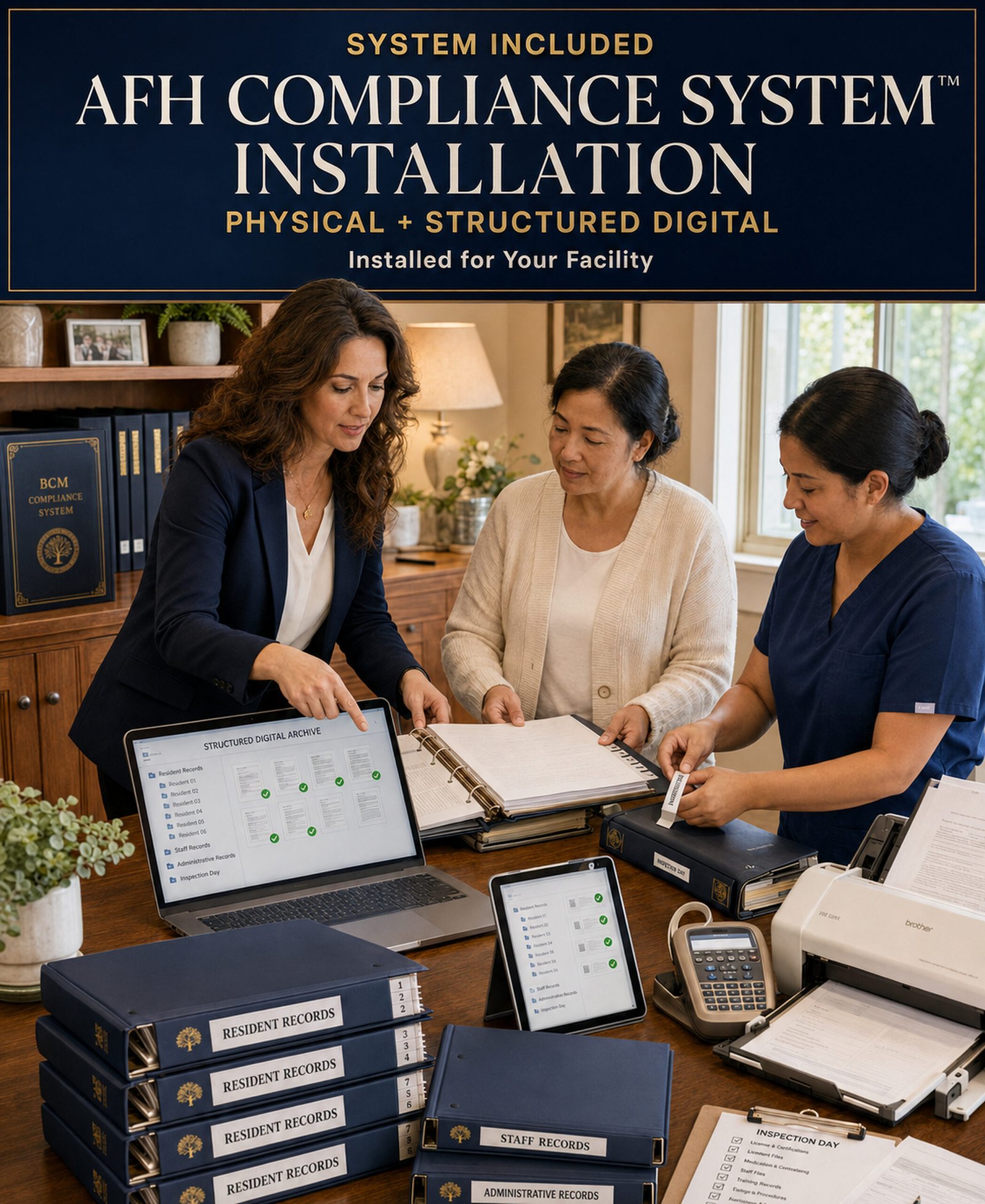
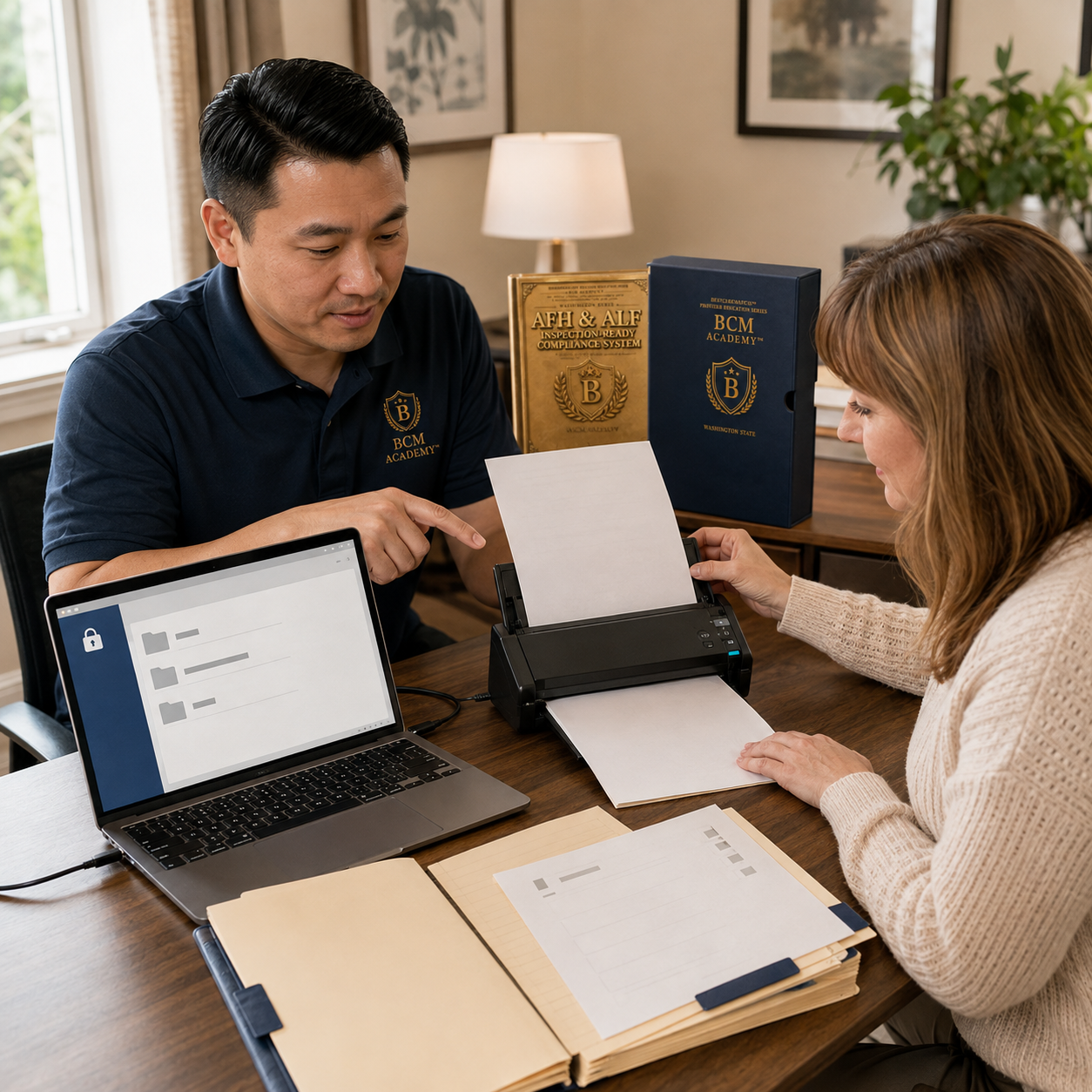
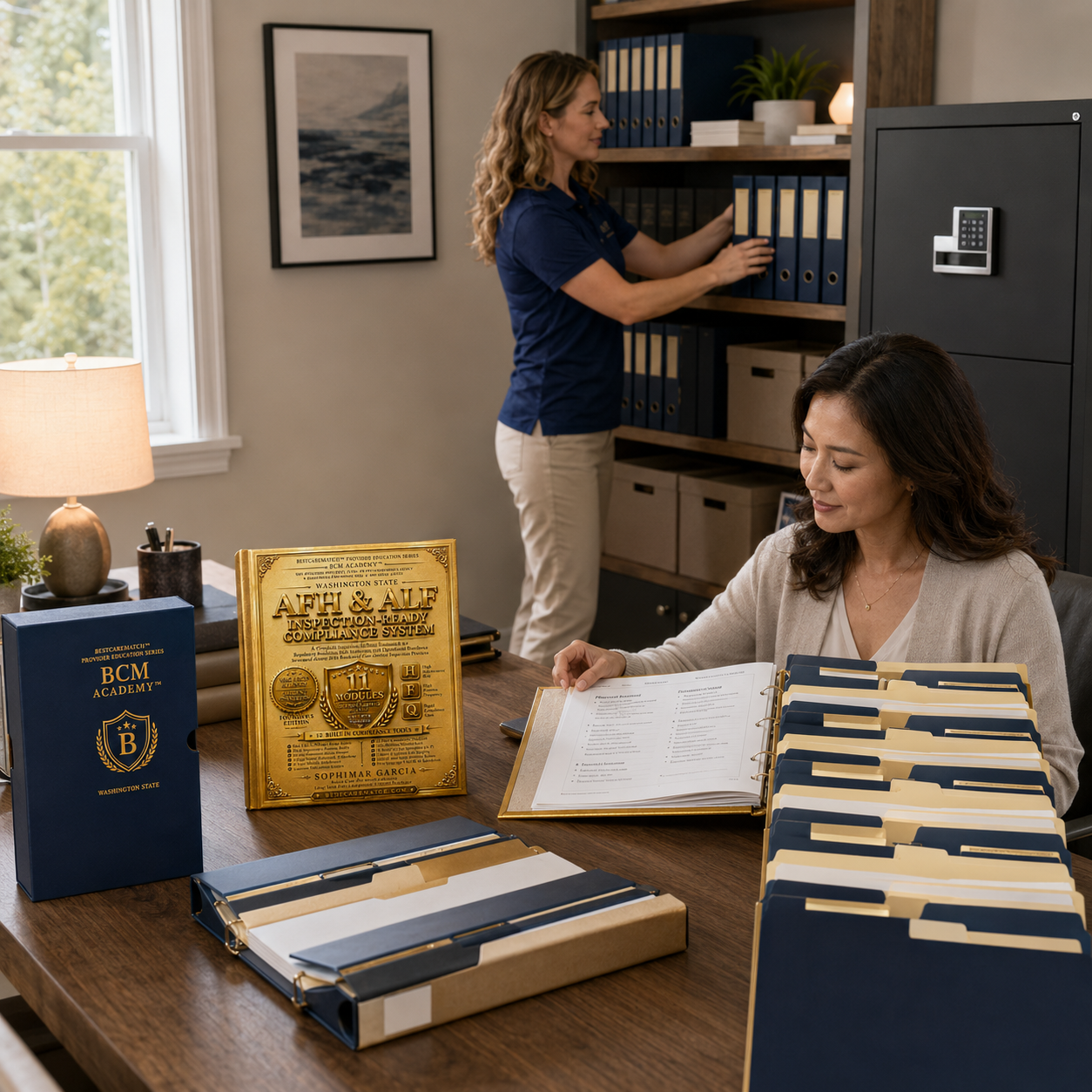
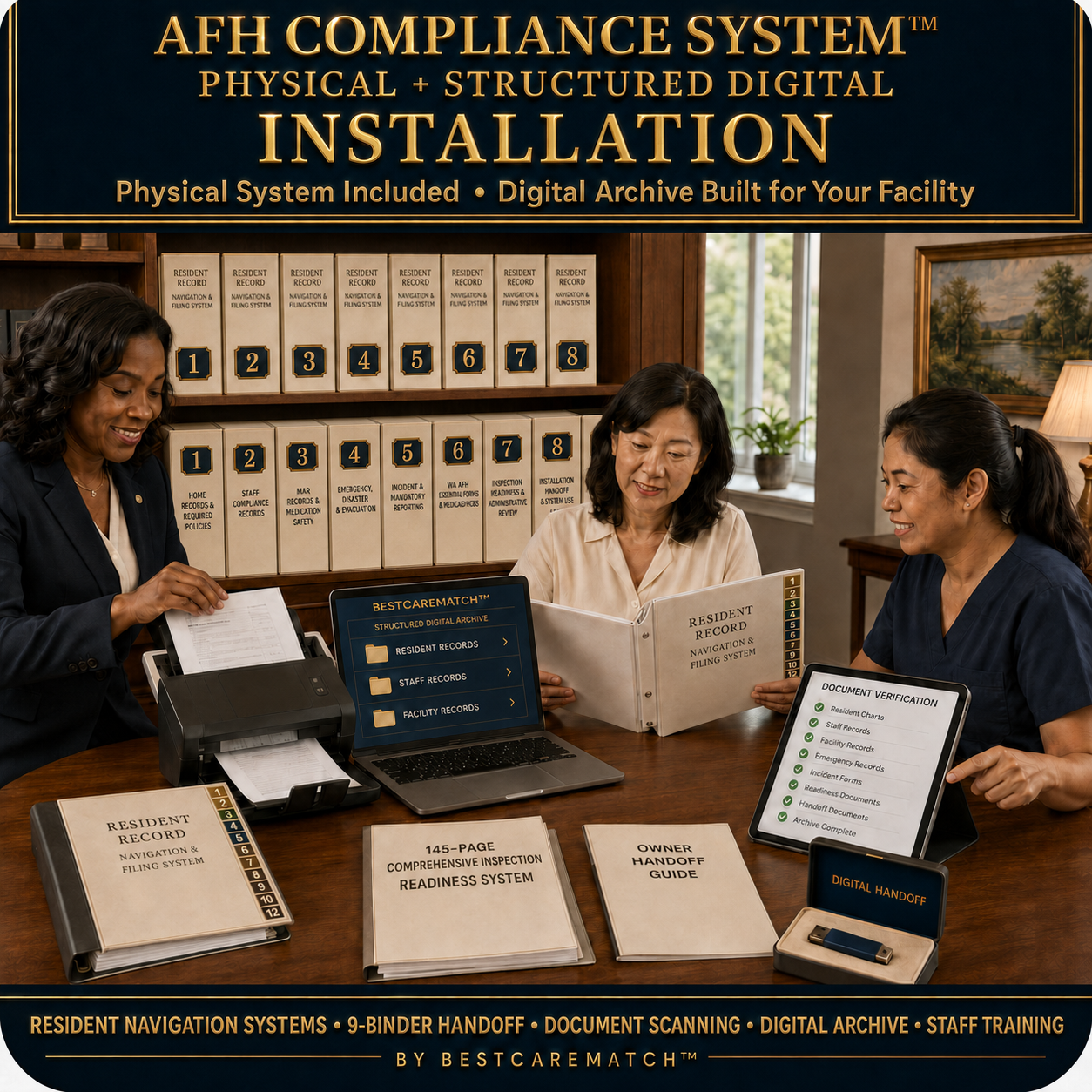
Ten installed system binders—plus proprietary resident architecture
Know what is required. Know where it belongs. Know what still needs attention.
BCM starts with the Resident Record Navigation & Filing System™, a protected numbered filing system that helps your staff know where records belong and how to find them. Ten included binders support the home’s other records and daily work. Both options include the full physical installation; Physical + Structured Digital also adds an organized archive controlled by your facility.
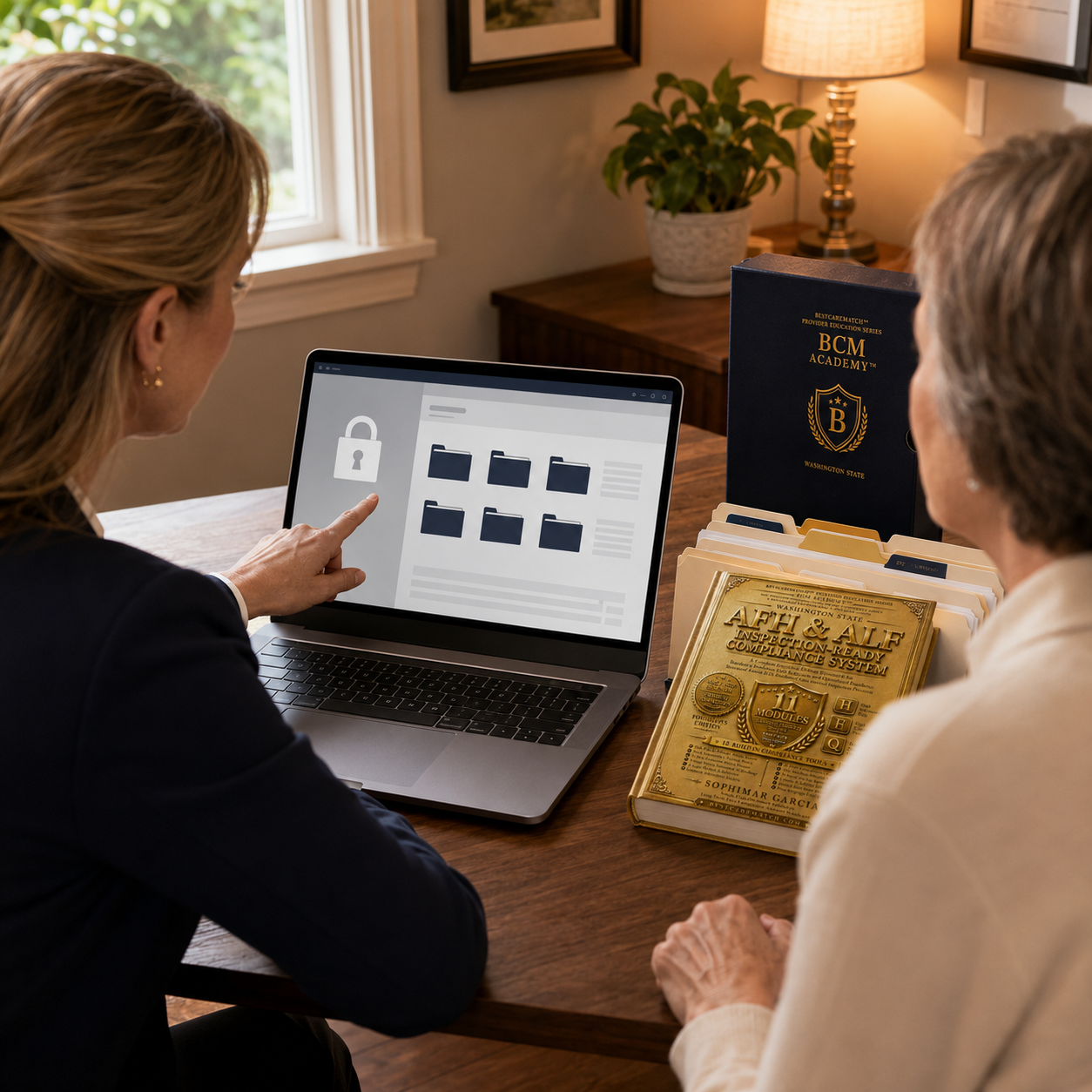
The exact WooCommerce variation price appears before Add to Cart. The separately sold hardbound Washington AFH & ALF Inspection-Ready Compliance System is not included with this installation.
Choose correctly the first time
Two selections control the scope and price of your installation.
Active Resident Records
Select the exact number of active resident records expected at the confirmed project start: zero through eight. Do not select only by licensed bed capacity.
Installation Pathway
Choose Physical Installation for the complete onsite paper-system handoff. Choose Physical + Structured Digital when the same complete physical installation must also receive controlled document capture, naming, indexing, digital organization, reconciliation, and digital handoff within the selected allowance.
Exact Variation Price
The combination of active-resident count and pathway determines the product variation and published price. The WooCommerce selection shown before Add to Cart must match your choices.
What is handed off
A proprietary resident-record foundation—extended by ten installed facility-use systems.
The resident navigation system is the organizing foundation: one protected 12-tab numbered logic, section-level tables of contents, definitions, use guidance, and clear Required and Helpful indicators that help designated staff understand what belongs, what supports the record, and what still needs follow-through. The ten physical system binders extend that logic across applicable reference pathways, current-at-handoff public forms and guidance, policies, working logs, staff records, medication documentation, emergency and incident processes, admissions and discharge workflows, self-audit tools, and inspection readiness.
Proprietary Resident Record Navigation & Filing System™
One installed proprietary 12-tab BCM architecture for each selected active resident, with cover leaves, chart identity, spines, locators, and protected filing logic provided to the purchasing facility.
Facility Operating Systems
Organized binders for home records and policies, staff requirements, medication records, emergency preparation, incident reporting, essential forms, and inspection preparation.
Customized Facility Pathways
Admissions, discharge and transfer, owner or staff handoff, and mock-inspection or “show me” resources are adapted to the home’s confirmed workflow and priorities.
Usable Chart Expansion
When a resident record becomes too thick for safe, practical navigation, BCM may divide it into clearly coordinated Chart A and Chart B volumes instead of forcing the record into one overcrowded binder.
Readiness + Handoff Resources
Facility-specific checklists, self-audit tools, mock-inspection prompts, interview preparation, workflow guidance, and owner or designated-staff handoff materials are organized within the confirmed scope.
Training + Guided Support
Designated staff receive system-use training, practical handoff guidance, and implementation support for questions arising through Day 30.
BCM’s protected resident-record architecture
A filing system staff can learn—without publishing the map they receive.
When staff file records in different ways, finding one document can take longer than it should. BCM installs a shared numbered filing system and teaches designated staff how to use it. The detailed filing map is provided privately to the purchasing facility.
Required documentation becomes visible
Section guidance identifies records classified as Required within the installed BCM structure, helping staff see which expected items still need follow-through.
Helpful support is distinguished
Helpful materials are identified separately so staff can strengthen the working record without confusing support tools with required documentation.
A sequence designed to be learned
The same numbered pathway is repeated across resident systems so designated staff can build familiarity, improve retrieval, and reduce dependence on one person’s memory.
Each section explains itself
Tables of contents, definitions, and use instructions help staff understand what the section is for and how to continue the filing method after handoff.
Missing work is easier to notice
An assigned location and expected-document guide make an empty or incomplete area more visible than records scattered under inconsistent tabs.
Thick records remain navigable
When record volume warrants it, coordinated Chart A/B expansion preserves the same navigation logic instead of creating a second unrelated filing method.
Ten included offline facility-use extensions
The ten system binders bring the home’s daily operating and readiness tools within reach.
The proprietary resident navigation system establishes the repeatable filing foundation. Ten additional facility-use system binders extend that order across home operations, staff records, medication, emergency, incident, forms, admissions, discharge, and inspection readiness—physically present for authorized staff to reference, review, practice, and maintain without depending on internet availability.
One source-of-truth location
Each record family receives a defined primary filing location so staff are not forced to guess between shelves, drawers, loose packets, and duplicate copies.
Daily workflow becomes repeatable
Clear binder identity, locators, labels, and filing logic help designated staff know where new documentation belongs and how to continue the system after installation.
Owner oversight becomes visible
The system helps your team see what is missing, what is due, who is responsible, and what needs follow-up.
Resident and facility evidence connect
Resident-specific records remain separate and confidential while locators connect them to the appropriate facility-level systems without uncontrolled duplication.
Transitions have a defined pathway
Admissions, Medicaid and private-pay documentation, discharge, transfer, and historical record routing receive structured locations instead of being handled as one-off events.
Readiness becomes a maintained process
Mock-inspection, food-preparation, fall-response, emergency-drill, abuse-prevention, interview, and self-audit resources remain organized for routine use—not only when an inspector arrives.
Staff changes do not erase the logic
System-use training, owner or staff handoff, and written maintenance controls help the structure remain understandable when duties are delegated or staffing changes.
Retrieval becomes more direct
A clear path to the designated system of record can reduce the time spent searching for documents during daily operations, internal review, and inspection preparation.
Living proof of facility-specific execution
The scope adapts when the records reveal that the home needs more.
In a completed multi-resident installation, two resident records had become too thick for practical use. BCM expanded those records into coordinated Chart A/B volumes, installed the home’s core operating and compliance-support systems, added customized workflows around the client’s requested needs, and developed facility-specific logo and emblem treatments carried across the handoff materials.
What this proof means: BCM can respond when real record volume and facility needs call for a stronger architecture than the original arrangement. It does not promise identical chart splits, page counts, customized workflows, or branding to every purchaser; the final configuration is confirmed privately and in writing.
The core facility architecture
Ten facility-use system binders organize the home beyond resident charts.
Home Records & Required Policies
Facility identity, required records, operational policies, applicable WAC and RCW reference pathways, and organized location guidance.
Staff Compliance & Training Records
Personnel documentation, requirement tracking, training records, and staff-readiness resources.
MAR Records System
Medication-administration documentation, related logs, guidance, and organized medication-record routing.
Emergency, Disaster & Evacuation Drill System
Emergency plans, drill documentation, evacuation records, and readiness materials.
Incident & Mandatory Reporting System
Incident documentation, reporting pathways, follow-through records, and organized supporting materials.
WA AFH Essential Forms & Medicaid Reference
Applicable public DSHS forms, Washington AFH working resources, and Medicaid reference pathways within the confirmed scope and current at handoff.
Inspection Day Readiness & Self-Audit
Readiness assessment tools, mock-inspection resources, self-audit materials, and practical preparation guidance.
Available where the work happens
Your staff can reach the installed system without depending on an internet search.
Authorized staff can go to a defined onsite location for the home’s organized reference pathways, working tools, and permitted facility-use forms. That reduces repeated searching and gives the team a consistent starting point during daily work, internal review, training, and inspection preparation.
Onsite reference access
Applicable WAC and RCW pathways, DSHS public guidance, and facility materials are organized by operating purpose so staff know where to begin.
Working forms within reach
Permitted public and facility-use forms can be retrieved and photocopied or printed for authorized operational use without rebuilding the source search each time.
Staff continuity
Shared labels, record guides, and instructions help staff keep filing consistent when someone takes over a task or joins the team.
Current-at-handoff control
BCM organizes materials current at the installation handoff and identifies official-source pathways so the provider can verify updates and replace superseded versions.
The operational transformation
The value comes from ten installed systems working together—and what that structure allows the home to do.
| Before installation | Installed BCM response | Practical value to the home |
|---|---|---|
| Resident records accumulated under different filing habits | BCM Proprietary Resident Record Navigation & Filing System™ for each active resident | Designated staff learn a shared way to file and find records. The detailed filing map remains private to the purchasing facility. |
| Oversized charts become difficult to turn, review, and maintain | Coordinated Chart A/B expansion when record volume warrants it | The complete record remains organized without forcing everything into one unusable volume. |
| Facility records are dispersed across shelves, drawers, and staff memory | Ten installed facility-use system binders: seven core systems plus three confirmed customized systems | The home receives visible ownership, location, maintenance, and handoff pathways. |
| Inspection preparation begins by searching for what may be missing | Readiness, self-audit, mock-inspection, interview, and “show me” resources | Preparation becomes a repeatable internal process rather than a last-minute document hunt. |
| Only one person understands the existing arrangement | Designated-staff training, owner or staff handoff, and Day-30 support | The structure is easier to continue when responsibilities shift. |
| Physical and digital copies follow unrelated naming patterns | Optional matching structured digital archive | Resident, staff, and facility files can follow a coordinated physical and digital logic. |
Why the investment is different
This is not a basic binder order, software subscription, or scanning transaction.
The purchase combines facility-specific system architecture, ten installed facility-use systems, proprietary resident-record organization, physical implementation, staff handoff, training, Day-30 support, and—when selected—a structured digital conversion project.
| What a simpler purchase may provide | What BCM installation performs | Why the difference matters |
|---|---|---|
| Empty binders, generic templates, or loose packets | Ten configured facility-use system binders plus proprietary resident-record systems for the selected active-resident count | The facility receives an installed operating and record architecture—not empty containers. |
| Software access after information is entered | Inventory, physical organization, filing architecture, staff handoff, and selected historical-record conversion | Access alone does not organize legacy source records or install the home’s physical workflow. |
| Unindexed document scanning | Controlled capture, naming, folder structure, indexing, reconciliation, and documented exceptions within the selected allowance | The digital deliverable is organized for facility retrieval rather than handed back as an undifferentiated scan folder. |
| Advice without implementation | On-site setup, designated-staff system-use training, practical handoff, and guided support through Day 30 | The team is shown how to continue the installed structure after the project handoff. |
Complete installation pricing
Match the active-resident workload to the correct pathway and price.
Every pathway includes the complete physical facility-use handoff. Physical + Structured Digital adds the stated digital allowance and organized facility-controlled archive. Select the active-resident count expected at the confirmed project start.
Digital scope: empty folder architecture, naming protocol, index, access framework, and backup-responsibility checklist. No resident-source scanning.
Digital allowance: up to 2,000 scan images.
Digital allowance: up to 4,000 scan images.
Digital allowance: up to 6,000 scan images.
Digital allowance: up to 8,000 scan images.
Digital allowance: up to 10,000 scan images.
Digital allowance: up to 12,000 scan images.
Expanded scope: seven resident-record systems and up to 14,000 scan images with digital. Select only when seven active resident records are within the facility’s authorized operating scope.
Expanded scope: eight resident-record systems and up to 16,000 scan images with digital. Select only when eight active resident records are within the facility’s authorized operating scope.
One physical foundation. One optional digital layer.
Both pathways include the complete physical handoff.
Physical System Installation
- Ten provided facility-use system binders: seven core systems plus three scope-confirmed customized systems
- BCM Proprietary Resident Record Navigation & Filing System™ for each selected active resident, additional to the ten facility systems
- Cover leaves, spines, labels, locators, numbered tabs, and protected filing architecture
- Chart A/B expansion when record volume makes it operationally appropriate
- Applicable reference pathways, public forms, readiness, mock-inspection, self-audit, and handoff resources within the confirmed scope
- On-site setup, designated-staff training, handoff, and guided support through Day 30
Physical pathway boundary: scanning, OCR, searchable digital files, digital indexing, EHR software, eMAR, and live clinical software are not included.
Physical + Structured Digital Installation
- Everything included in the complete physical pathway
- Controlled document capture within the selected variation’s scan allowance
- Consistent file naming and structured resident, staff, and facility folders
- Digital index, filing verification, reconciliation, and documented exceptions
- Typed-text OCR when technically successful
- Secure handoff of the organized, facility-controlled digital archive
Digital pathway boundary: the deliverable is an organized internal archive—not an EHR platform, eMAR, live-charting application, certified health IT, vendor integration, or guaranteed future software import.
What BCM needs before scheduling
A prepared facility protects the implementation timeline.
Confirmed decision owner
Identify the owner, provider, resident manager, or authorized project lead who can answer scope questions and approve facility-specific decisions.
Appropriate record access
Provide lawful, authorized onsite access to the records and facility areas required for the confirmed work. Do not send resident-identifying records through an ordinary inquiry email.
Available source records
Gather active resident records, staff records, facility files, existing policies, forms, and relevant working logs so BCM can assess actual volume and condition.
Printing support
The facility provides working printer or copier access, paper, ink, and other preparation materials identified in the written scope. BCM provides and configures the ten included facility-use system binders and proprietary numbered-tab architecture described on this page.
Digital equipment and access
When Structured Digital is selected, confirm power, suitable workspace, approved storage destination, authorized access, and the facility’s backup responsibility before document capture begins.
Participating designated staff
Ensure the staff members expected to use and maintain the system are available for the confirmed training and handoff period.
Facility identity and branding
A premium system should look intentional—but branding terms must remain clear.
Project-specific precedent
A completed six-resident installation received three custom logo and emblem treatments, with facility branding carried across relevant binder covers and handoff pages.
Six-resident consideration
Six-resident installations may be considered for a complete facility-branding treatment based on the confirmed project arrangement and implementation scope.
Smaller-scope consideration
Smaller installations may be offered discounted facility-branding development when appropriate. No fixed branding discount is promised on this product page.
From order to working handoff
A privately confirmed, project-based implementation.
Variation review
BCM confirms the selected resident count, pathway, facility location, and purchaser contact.
Record + facility assessment
Volume, source condition, current storage, physical environment, priority needs, and requested customization are reviewed.
Written scope
Access, materials, digital allowance, add-on systems, branding terms, participating staff, boundaries, and timing are confirmed.
Installation
BCM organizes and installs the physical architecture and, when selected, builds the matching structured digital archive.
Training + Day 30
Designated staff receive system-use training, handoff guidance, and included implementation support through Day 30.
Project-based—not hourly: The purchase is for the confirmed installation deliverables, not a promised number of labor, scanning, consulting, design, or training hours.
Read before ordering
Clear boundaries protect the value of the installation.
One Washington AFH
Each product variation covers one facility location and the selected active-resident count.
System configuration adapts
Resident chart splits, final physical volumes, customized systems, and handoff page counts depend on actual record volume and the written scope.
Standalone book excluded
The separately sold hardbound Washington AFH & ALF Inspection-Ready Compliance System is not included and must be purchased separately if desired.
Digital volume is controlled
Digital work follows the scan allowance of the selected variation. Additional volume requires written approval.
Originals are preserved
Original-record destruction is not included. The facility remains responsible for retention, access, and ongoing record maintenance.
Facility adoption remains required
BCM templates and model policies are independent support materials—not DSHS-approved simply because they are included. The provider must review, adapt, adopt, sign or date when applicable, implement, and maintain them; only documents with a specific department-approval or submission requirement should be treated that way.
No inspection guarantee
BCM organizes systems and supports readiness; it does not represent DSHS, certify compliance, replace required training, or guarantee an inspection result.
Buying questions
What providers need to know before checkout.
Are the complete physical facility-use systems included in both pathways?
Yes. The complete physical installation—including the core facility architecture—is included in both pathways. Physical + Structured Digital adds the organized digital layer; it does not replace the physical handoff.
How many facility-use system binders are included?
Ten. Seven binders contain the core home records and policies, staff compliance, medication records, emergency readiness, incident and reporting, essential forms and reference pathways, and inspection-readiness systems. Three additional binders support confirmed customized workflows for admissions, discharge and transfer, and mock-inspection or “show me” readiness. Proprietary resident chart systems are additional and follow the selected active-resident count and actual chart volume.
What does “proprietary resident navigation” mean?
The BCM Resident Record Navigation & Filing System™ uses a protected 12-tab numbered architecture, locator method, chart identity system, Required and Helpful record indicators, section tables of contents, definitions, use guidance, and filing logic developed by BestCareMatch. Purchasers receive the working system and training; the public product page and product images intentionally do not disclose the internal filing map or category sequence.
Does completing every space in the navigation system prove compliance?
No. The system improves organization, makes identified requirements and open follow-through more visible, and supports more consistent record retrieval. Compliance depends on the accuracy, completeness, timeliness, implementation, and maintenance of the records and facility practices under current official requirements.
Will every resident record remain in one physical volume?
Not necessarily. The selected variation is based on active residents, not final physical volume count. When an individual record is too thick for practical navigation, BCM may coordinate an A/B split within the confirmed scope.
Is a custom facility logo automatically included?
No. Branding is reviewed during scope confirmation. Six-resident projects may be considered for a complete facility-branding treatment; smaller projects may receive discounted branding. Exact terms must be confirmed in writing.
Does this installation include the separately sold $497 hardbound compliance system?
No. The standalone Washington AFH & ALF Inspection-Ready Compliance System is a separate product. This purchase is for facility-specific installation, record architecture, customized systems, staff handoff, and the selected digital work.
Does Physical + Structured Digital include the complete physical-system installation?
Yes. It includes all ten physical facility-use system binders, resident chart systems for the selected active-resident count, installation, and handoff. It then adds document capture, naming, structured folders, indexing, verification, and digital handoff within the selected allowance.
Which resident count should I select?
Select the exact number of active resident records expected at the confirmed project start. Empty future spaces do not replace the active-record count used for the purchased variation.
Why can a monthly software subscription cost less than BCM installation?
They are different purchases. A subscription generally purchases continued access to software. BCM installation purchases facility-specific physical organization, ten installed facility-use systems, resident-by-resident proprietary architecture, historical-record organization, staff training, handoff, and—when selected—structured digital conversion within the stated allowance.
Does this purchase include a future BCM software platform or subscription?
No. This purchase covers the installation described on this page. If a separate BCM beta later launches, any participation, migration, functionality, security review, synchronization, duration, or post-beta price would require separate terms and is not promised by this purchase.
Will a future BCM platform automatically receive or synchronize these records?
No automatic migration, import, integration, or synchronization is promised. Any future connection would depend on tested capabilities, supported formats, security controls, written scope, and facility authorization at that time.
Why does the zero-resident Structured Digital pathway cost more than Physical?
The $1,997 pathway establishes the matching digital folder library, naming protocol, index, access framework, backup-responsibility checklist, demonstration, and training before resident paperwork begins. It does not charge for resident-source scanning when no active resident records exist.
Why are seven- and eight-resident variations separate?
Each additional active resident adds another proprietary physical resident-record installation and, when digital is selected, another 2,000 scan-image allowance. Select these variations only when the active-resident count is within the facility’s authorized operating scope.
What happens if the source volume exceeds the selected digital allowance?
BCM provides a separate written scope or approved change order before work beyond the purchased allowance proceeds.
Does the 30-day period mean 30 days of onsite work?
No. It is the defined guided implementation and support window—not a purchase or promise of consecutive onsite labor hours. The installation may finish earlier while included implementation support remains available through Day 30.
Does BCM guarantee a citation-free inspection?
No. BCM provides independent record-organization, implementation, and readiness support. The provider remains responsible for facility operations, resident care, staff performance, current requirements, and inspection outcomes.
Complete the product decision
Choose your resident count. Choose your pathway. Install the structure your home can keep using.
Return to the selectors above, confirm the exact variation price, and order one facility-specific Washington AFH record-system installation.
Independent BestCareMatch™ implementation and record-organization service. Not affiliated with or endorsed by Washington State, DSHS, ALTSA, or Residential Care Services. No inspection outcome or absence of citations is guaranteed.

Reviews
There are no reviews yet.