
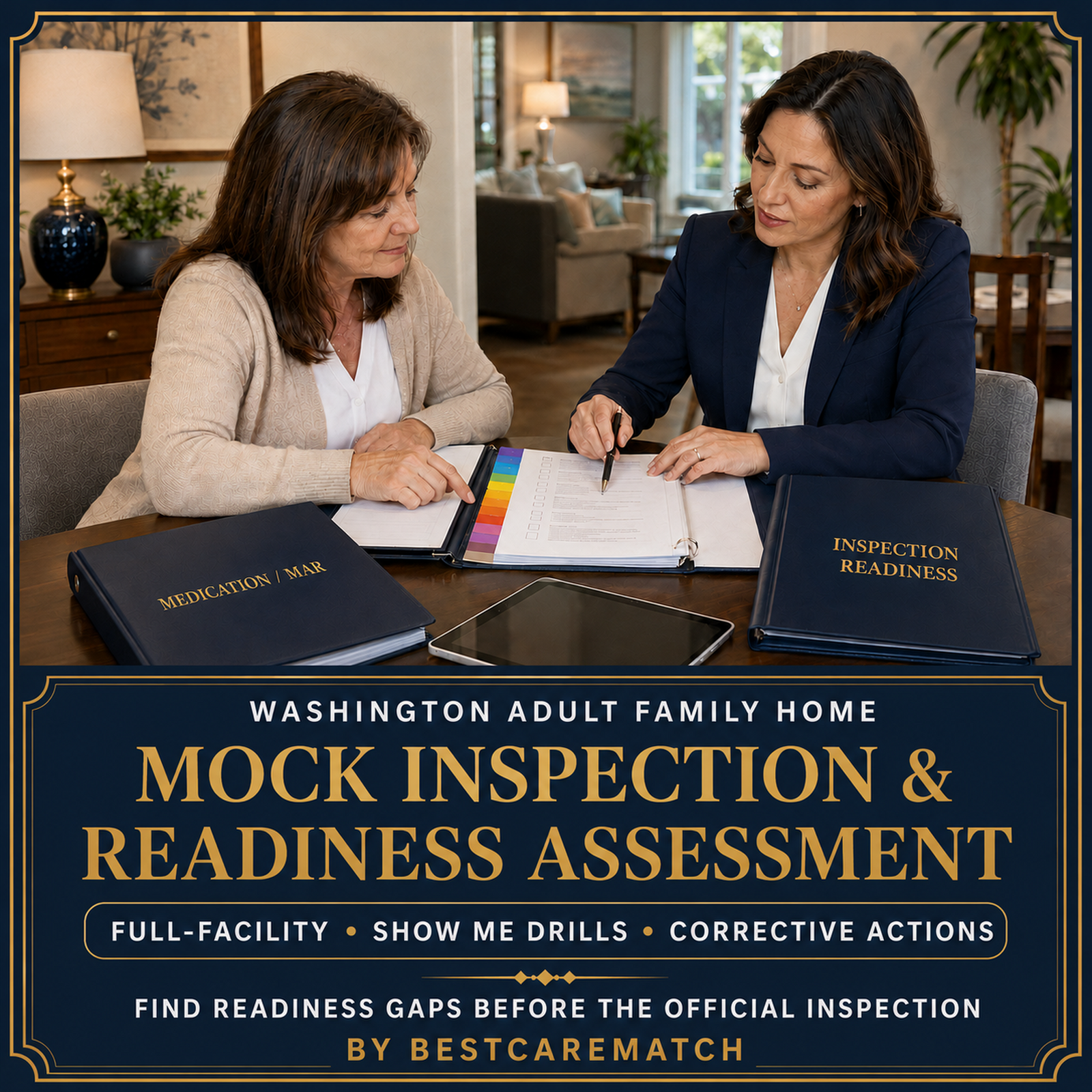


Independent On-Site Readiness Service for Washington Adult Family Homes
See readiness gaps before inspection pressure exposes them.
Inspection day should not be the first time your home tests its physical readiness, records, medication/MAR systems, staff response, and operating proof. This comprehensive one-day Washington AFH mock inspection begins with an active room-by-room review, then connects physical conditions with the evidence your team must retrieve, explain, and use through hundreds of structured checks and subchecks.
What Your Team Can Take From the Review
Understand what needs attention and where to begin.
For Washington adult family home owners, licensees, and resident managers who would like a practical review of the home, its records, and inspection preparation.
Look at the Home and Its Records Together
Review the physical home, medication administration records, selected resident records, staff preparation, and everyday practices together.
Learn a Review Process Your Team Can Reuse
Practice using the chart-review checklist with a model chart, then use what you’ve learned to review other charts and maintain records.
Know what to address first
We discuss immediate concerns as they are identified and review priorities with you. Written findings and correction guidance follow within 24–48 hours.
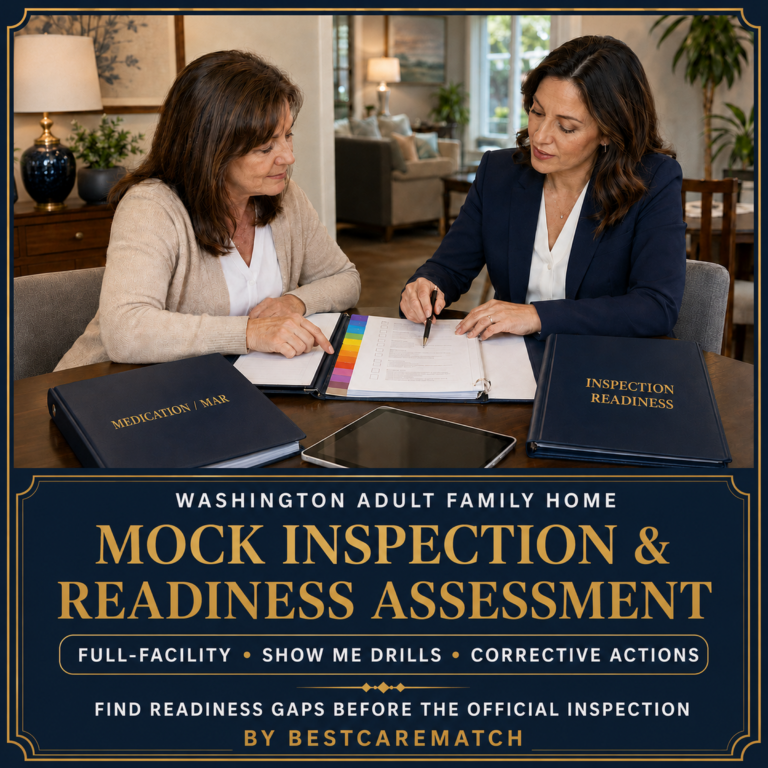
01 · Every-Room Physical Facility Review
Every accessible room, physical route, and observable safety condition is part of the review.
The day begins in motion with a systematic, noninvasive review of the accessible home. This is not an exterior check or general walkthrough. BCM examines how each space is arranged, maintained, accessed, and used.
Every Accessible Room
Resident bedrooms, caregiver quarters, bathrooms, kitchen, common areas, laundry, utility, office, storage, hallways, stairs, and other accessible spaces.
Access and Evacuation
Doors, windows, exits, evacuation routes, ramps, walkways, decks, exterior access areas, and paths used by residents or staff.
Bedrooms and Daily Use
Bed placement, transfer space, door and window access, furnishings, equipment, lighting, temperature, floors, walls, and repair.
Fire and Emergency Safety
Smoke alarms, extinguishers, heat sources, combustibles, blocked routes, emergency access, and observable fire or evacuation hazards.
Hazards and Dangerous Objects
Fall, trip, slip, collision, entrapment, sharp-object, electrical, chemical, scald, sanitation, and other incident-producing risks.
High-Use and Secure Areas
Bathroom safety, water temperature, kitchen and laundry flow, food and medication storage, chemicals, cleaning products, sharps, tools, and secured items.
02 · Inspector-Style “Show Me” Drills
Knowing the answer is different from being ready to demonstrate it.
Selected simulations test whether the provider or available staff can locate, explain, demonstrate, and respond when asked, in a calm learning environment rather than a punitive exercise.
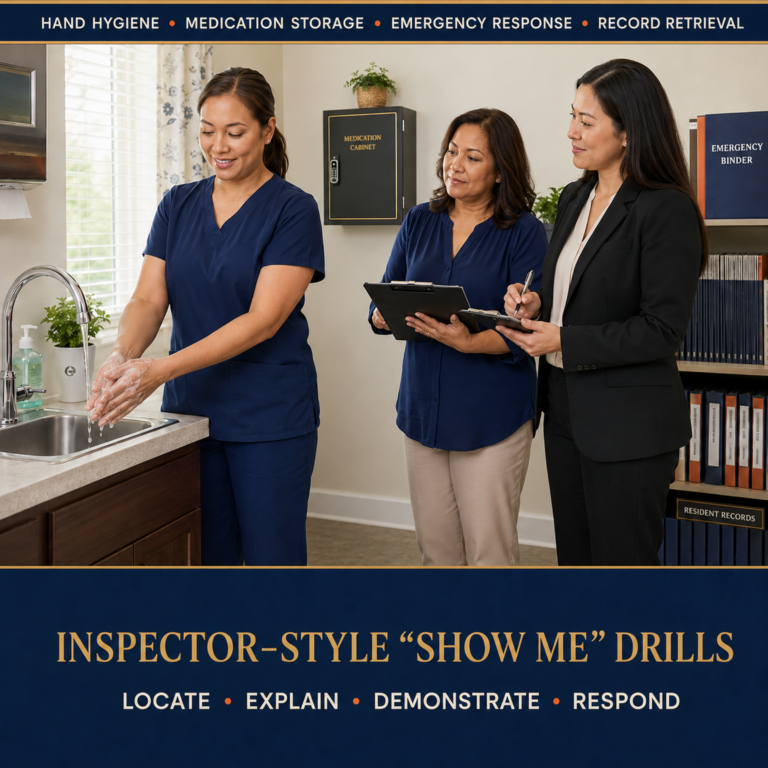
Locate
Practice finding selected resident records and supporting evidence without avoidable delay.
Explain
Describe medication storage, operating practices, and available proof with greater clarity.
Demonstrate
Use selected hand-hygiene, safety, or care-readiness demonstrations when appropriate.
Respond
Practice selected emergency, incident, and staff-response scenarios based on the visit.
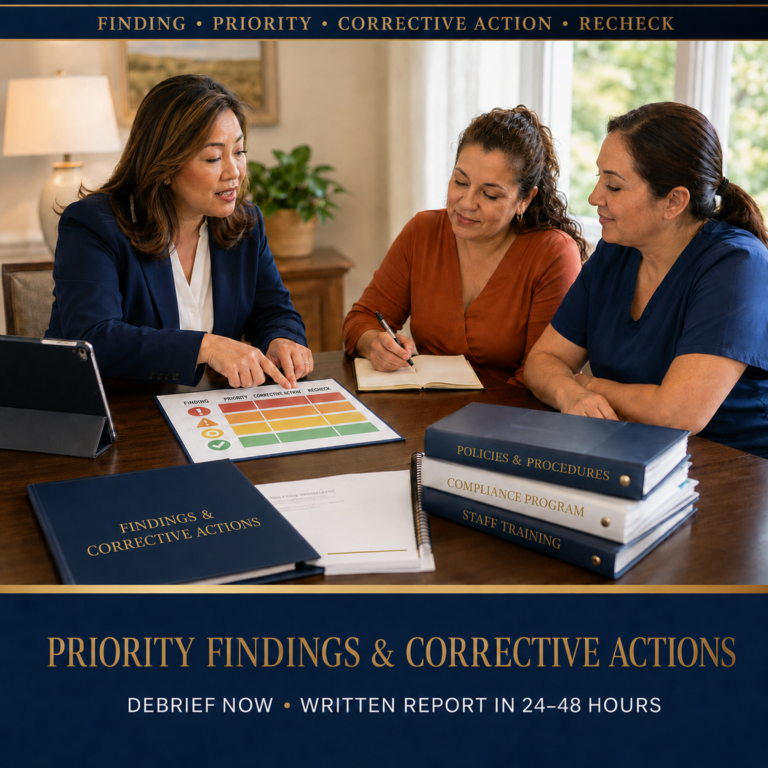
03 · Priority Findings and Corrective Actions
Leave with priorities, not a pile of observations.
Immediate safety or medication concerns are raised when seen. The priority debrief and written report turn observations into an organized path forward.
Finding
What was observed, unavailable, inconsistent, or not ready to demonstrate.
Priority
What deserves attention first based on safety, medication, evidence, and readiness impact.
Corrective Action
The practical next step, responsible person, and proof that may demonstrate completion.
Written Direction and Follow-Up
Organized findings within 24–48 hours, plus reasonable clarification by email or scheduled phone call as needed.
The readiness domains
Review the connected systems, not isolated paperwork.
Hundreds of structured checks and subchecks connect the principal systems of one licensed AFH. Depth varies with resident census, available evidence, staff participation, observed conditions, and areas requiring closer attention.
Whole-Home Physical Facility
Accessible rooms, routes, safety features, and observable incident-producing conditions.
Practical Model-Chart Training
BCM trains the provider to review a resident chart using one designated physical chart or up to two designated digital charts, as time, access, and inspection focus permit. The provider then uses the structured checklist to assess the remaining charts, complete missing forms, and maintain a repeatable operational readiness method.
Staff Files
Selected personnel records and supporting documentation.
Medication and MAR
Storage, access, orders, labels, MAR entries, monitoring, and documentation practices.
Policies and Logs
Principal facility records, required policies, and recurring logs.
Emergency and Incidents
Selected emergency, reporting, and incident-readiness elements.
What happens after you order
A full review day that begins in motion.
After a brief operational confirmation, action begins with the physical facility and moves purposefully among evidence, staff readiness, and priority findings as conditions require.
Room-by-Room Physical Review
Examine accessible rooms, routes, placement, storage, fire readiness, chemicals, sharp objects, fall risks, and other observable incident-producing conditions.
Medication, Records, and Staff Readiness
Connect physical observations with medication/MAR evidence, guided model-chart training, staff files, policies, logs, and selected “Show Me” drills. Learn how to use the provided checklist across the remaining charts as an ongoing operational guide.
Immediate Concerns and Clear Priorities
Raise significant concerns when identified, then clarify what needs protection now, what should be corrected next, and what may demonstrate completion.
Organized Findings and Follow-Up
Receive organized findings within 24–48 hours, plus reasonable clarification by email or scheduled phone call as needed.
A clear fit prevents wasted time
Know exactly what this service is and what it is not.
This service is a strong fit when you need:
- An independent readiness view before an official inspection
- A structured review across principal AFH systems
- Practical chart-review training that can continue in ongoing operations
- Prioritized corrective-action direction after the visit
This service does not include:
- An official DSHS or Residential Care Services inspection
- A guarantee against citations or regulatory findings
- An exhaustive audit of every page in every record
- Formal Plan of Correction preparation for an existing official citation
When preparation time matters
Do not let the official inspection become the first full test of readiness.
See the home through a structured readiness lens, learn a repeatable chart-review method, practice selected responses, and receive clear priorities while there is still an opportunity to address them.
Clear scope. Clear expectations.
Questions providers ask before scheduling.
What does the standard service include?
The service covers one licensed Washington Adult Family Home with up to six active residents, up to eight hours on-site, hundreds of structured checks and subchecks, guided model-chart training for physical or digital records, a completion checklist for the remaining charts, selected drills, a priority debrief, written findings within 24–48 hours, and follow-up clarification as needed. The provider, resident manager, or authorized designee should be available.
Does the physical review include every room?
Yes. The review covers every accessible room and physical area, including resident bedrooms, caregiver quarters, bathrooms, kitchen, laundry, common areas, storage, utility spaces, routes, exits, windows, and exterior access areas. Observable hazard and incident-producing conditions are checked. The review is noninvasive and excludes destructive testing, engineering analysis, and concealed building systems.
How does the model-chart review work for physical and digital records?
This is practical compliance-readiness training within the assessment. BCM teaches the review method using generally one designated physical chart because physical chart handling and navigation are more time-intensive, or up to two designated digital charts when system access and available time permit. The provider learns how to apply the structured checklist, then uses it to assess the remaining active-resident charts, complete missing forms, and support ongoing operational readiness. Exact depth depends on inspection focus, available documentation, time, access, and issues identified. The service does not include an exhaustive page-by-page audit of every chart.
What does follow-up support include?
The provider may email or arrange a phone conversation for reasonable clarification. Implementation, record correction or reorganization, digitization, ongoing consulting, staff training, and Plan of Correction preparation are separate services.
Does the mock inspection guarantee no citations?
No. BestCareMatch provides an independent readiness service. Regulatory findings and outcomes remain within the authority of the applicable agency.

Reviews
There are no reviews yet.